
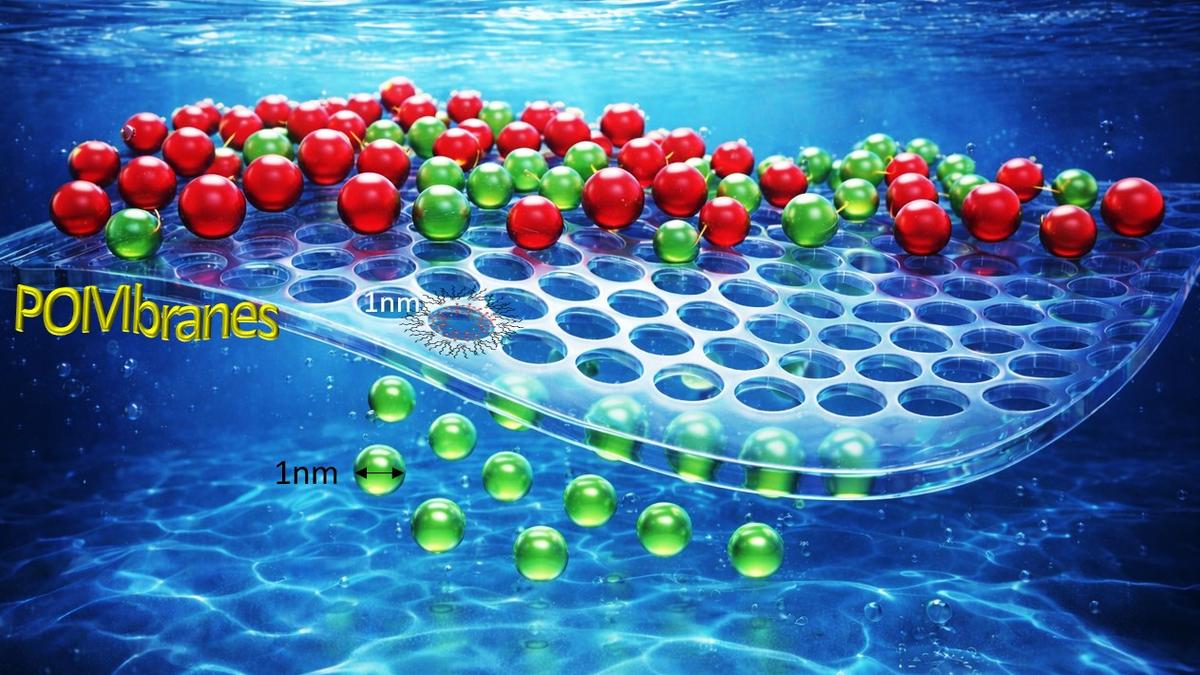
Ultra-precise “POMbranes” sieve out larger molecules (red) and allow only 1-nm species (green) to pass through, enabling sharp molecular sorting.
| Photo Credit: CSIR-Central Salt and Marine Chemical Research Institute, Bhavnagar
Imagine trying to filter sand from pebbles using a fishing net: it won’t work because the holes are too big and uneven. In chemistry, separating molecules that are almost the same size is just as difficult. However, a new study from IIT-Gandhinagar has offered a solution: a synthetic membrane capable of distinguishing between molecules with sub-nanometer precision.
At the heart of the solution is a type of cluster called a polyoxometalate (POM). The researchers focused on a cluster named P8 that has a crown-like structure. Imagine it to be a small, rigid donut. The hole in its middle is exactly 1 nm wide.
The fixed size is perfect for a filter because it never changes, unlike the flexible, uneven holes in standard plastic filters.
The find is significant because accurate separation is essential to purify water, capture carbon, and to manufacture certain medicines.
The study was published in Journal of the American Chemical Society on January 13.

On their own, the POM clusters form brittle crystals that are tough to use as filters. Instead, the researchers attached ‘tails’ made of alkyl chains to them. The tails acted like shock absorbers and glue, allowing the clusters to self-assemble into large and flexible thin films called POMbranes.
When the tails were too short, they couldn’t fill all the space between the donut clusters, leaving gaps between the donuts. Longer tails on the other hand packed tightly together and fully plugged the gaps.
The tail length also determined how the filter worked. In the version with short tails, called Q4, water and molecules could flow through both the donut holes and the gaps between them. This made the filter work faster but less precise. In the versions with long tails, Q7 and Q10, the gaps were blocked, forcing all the liquid to pass through the 1-nm holes in the centre of the P8 clusters. Thus the POMbrane was a very precise sieve.
In tests, Q7 and Q10 blocked molecules larger than 1 nm and let smaller ones through. They could also separate molecules that differed in weight by just 100-200 daltons, about 10x better than current membranes.
“These membranes are flexible, stable across different acidity levels, and can be manufactured in large sheets,” CSIR-Central Salt and Marine Chemical Research Institute principal scientist and study co-author Ketan Patel said in a release. “This combination is essential if the membranes are to be adopted widely in industry.”
Published – February 02, 2026 09:00 am IST